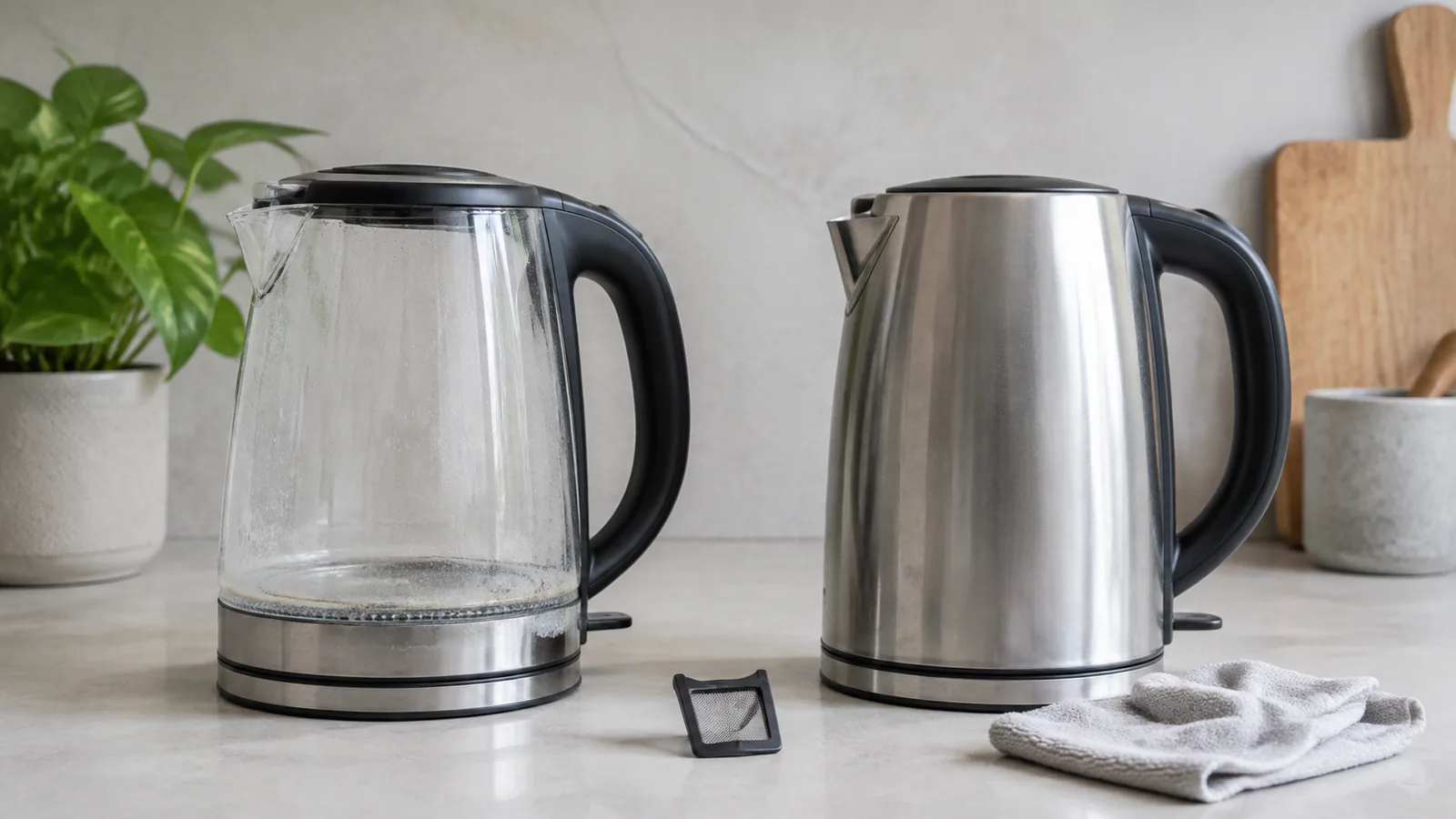
Neither glass nor stainless steel prevents limescale. Glass makes the deposit visible sooner; stainless steel can make the same maintenance easier to postpone. For less cleaning friction, compare the opening, interior seams, heating plate and filter before you compare shell material.
That distinction matters because many kettle guides turn a daily maintenance question into a material contest. The evidence points elsewhere: hard water creates the scale, while product construction decides how easily you can see, reach and remove it.
Hard water creates the scale—not the glass or steel
The UK Drinking Water Inspectorate explains that water hardness comes from dissolved calcium and magnesium. When hard water is heated, those minerals form deposits in kettles and on heating elements. Its guidance classifies water above 200mg/L as CaCO3 as hard and above 300mg/L as very hard, while also warning that hardness varies locally.
That does not mean you need a universal hardness cutoff before buying a kettle. It means the same kettle can look low-maintenance in one home and scale quickly in another. Your local water report or the deposit already forming in your present kettle is more useful than a claim that glass or stainless steel is inherently "scale-free."
Good Housekeeping's 2026 cleaning guide makes the same practical point from another direction: the interior cleaning methods are the same for glass, ceramic and stainless-steel electric kettles. Material changes what you see and how carefully you handle the surface; it does not remove the need to descale.
Glass helps you see the problem—but you also see every mark
Transparency is a real maintenance feature. You can see the water level without opening the lid, and a pale mineral ring is difficult to miss. That can be useful if visual evidence prompts you to clean before flakes reach the cup or buildup thickens.
Tom's Guide tested one Cosori glass kettle in Bath, England, a hard-water area. After six boils, visible limescale had appeared on the glass walls. The review did not show that every glass kettle needs cleaning after six boils. It showed how quickly a transparent wall can reveal what an opaque wall would hide under the same water conditions.
The downside is cosmetic work. Water droplets, steam haze and a thin mineral film remain visible even when the kettle is working normally. On Kaspi's Kazakhstan page for a Xiaomi glass-and-metal kettle, one owner specifically noted that water drops stayed visible inside. The same page lists a fixed lid and a scale filter—useful reminders that "glass" does not tell you whether your hand can reach the base or whether the filter is easy to remove.
Stainless steel can look calmer without being cleaner inside
An opaque stainless-steel wall hides sidewall scale from normal view. If you dislike a kettle that looks spotted between cleanings, that can be a genuine benefit. It is not proof that less scale is forming.
Stainless steel also moves some visible maintenance to the outside. In Tom's Guide's test of the Dualit Architect, the removable limescale filter was easy to take out and refit, but the stainless exterior showed fingerprints and needed frequent wiping. A matte finish may show fewer marks than polished steel, so even "stainless steel" is too broad to predict exterior upkeep.
The strongest counterexample to the glass-visibility argument is construction. In an r/tea discussion, an owner described buildup where a glass wall met the metal base. A reply recommended a seamless stainless interior because it removes that particular crevice. This is a useful design question, not a failure-rate statistic: one post cannot prove that glass seals commonly fail or that every steel kettle is seamless.
Five details predict cleaning friction better than material
| Check before buying | Why it matters | What to look for |
|---|---|---|
| Local water hardness | Sets how quickly mineral deposits can form | Water-supplier report or experience with your current kettle |
| Lid and opening | Decides whether a soft cloth can reach the base and walls | Wide opening, lid that stays clear of your hand, no sharp inner rim |
| Interior seams | Crevices can trap deposits even when the visible wall wipes clean | Smooth joins around the base, spout and water-level window |
| Heating surface | A flat concealed plate is easier to reach than an exposed coil | Smooth base and exact manual cleaning instructions |
| Limescale filter | A filter can catch flakes, but only if it fits and can be cleaned | Removable, washable mesh with no bypass gaps |
A removable filter does not stop scale forming inside the kettle. It can reduce the flakes that pour into a cup and makes one maintenance point easier to inspect. A fixed filter may still work, but you should check whether you can rinse both sides without awkward brushing.
Choose by the cleaning habit you will actually keep
Choose glass if seeing the water level and the first mineral ring will help you clean on time. Accept that clear walls display droplets and scale between cleanings, and check the glass-to-base joint rather than judging the kettle only from a front photo.
Choose stainless steel if you prefer an opaque body, a calmer-looking counter and possibly a seamless interior. Check the lid opening and water-level gauge, because an interior that is hard to see can also be hard to inspect. If exterior appearance matters, compare matte and polished finishes rather than treating all steel bodies alike.
Whichever material you choose:
- Inspect the inside in product photos. Search the exact model plus
inside,lid opening,limescale filterandcleaning. - Read medium and low reviews for repeatable conditions. Give more weight to comments that name water hardness, months of use, the deposit location and what cleaning method was attempted.
- Follow the exact manual. Acids, concentrations, boiling instructions and rinsing steps vary by model. Do not copy an aggressive internet recipe into a kettle whose manual forbids it.
- Stop if you cannot reach a persistent seam or the kettle leaks. Cleaning cannot repair a failing seal, damaged coating or unsafe electrical joint.
Where two current COSONIC kettles fit
The current public record for COSONIC CSK-8855 lists a 2.5L capacity, 2000W input, water-level indicator and removable, washable filter. Those are relevant comparison points if filter access is more important to you than a material label.
The current record for COSONIC CSK-8804 lists a 2L capacity, one-touch lid switch, anti-calc filter and stainless-steel heating element. The last phrase describes the heating element; it should not be expanded into a claim that the whole kettle body is stainless steel.
Neither public record confirms the body material, opening width, interior seam design or a descaling interval. Check the exact local version and manual before choosing. You can also compare the current kettle range, using the five details above rather than assuming one shell material stays cleaner.
The honest conclusion
Glass and stainless steel change the visibility and appearance of maintenance. They do not change the mineral content of your water.
For a kettle that feels easier to keep clean, prioritize a reachable smooth interior and a removable filter. Then choose glass if visible scale helps you act, or stainless steel if you prefer to hide wall marks between inspections.
Sources and evidence
- UK Drinking Water Inspectorate: Water hardness — Official explanation of calcium, magnesium and scale in heated appliances; local hardness varies.
- Good Housekeeping: How to clean an electric kettle — Same interior cleaning principle across glass, ceramic and stainless steel, with gentle handling and filter removal.
- Tom's Guide: Cosori glass kettle review — One hard-water test location and one model; visible scale after six boils is not a universal schedule.
- Tom's Guide: Dualit Architect review — One stainless-steel model separating removable-filter access from exterior fingerprint upkeep.
- Reddit r/tea: buildup at a glass-to-metal base — Individual owner report and seamless-steel counterargument; not comparative reliability data.
- Reddit r/AskUK: regional descaling experiences — Conflicting cleaning frequencies and a visibility benefit reported by glass-kettle owners.
- Kaspi.kz: Xiaomi Electric Glass Kettle reviews — Kazakhstan listing and individual comments; no claim about sales or universal cleanability.
Kettle-cleaning questions shoppers ask
Does a glass kettle get more limescale than stainless steel?
Not because it is glass. Water hardness, heating and use determine scale formation. Glass simply makes deposits on the walls easier to see.
Is a stainless-steel kettle easier to clean?
It can be if the interior is smooth and seamless and the lid opens wide. A narrow opening, fixed filter or hidden crevice can make a steel kettle harder to clean than a well-designed glass model.
Does a limescale filter prevent buildup?
No. It can catch loose flakes before they enter the cup. The kettle interior still needs descaling according to the exact manual and local water conditions.
Should I descale on a fixed schedule?
Use the exact manual and your water conditions. A transparent kettle can help you see when deposits begin; an opaque kettle should be inspected intentionally rather than cleaned only when boiling slows.