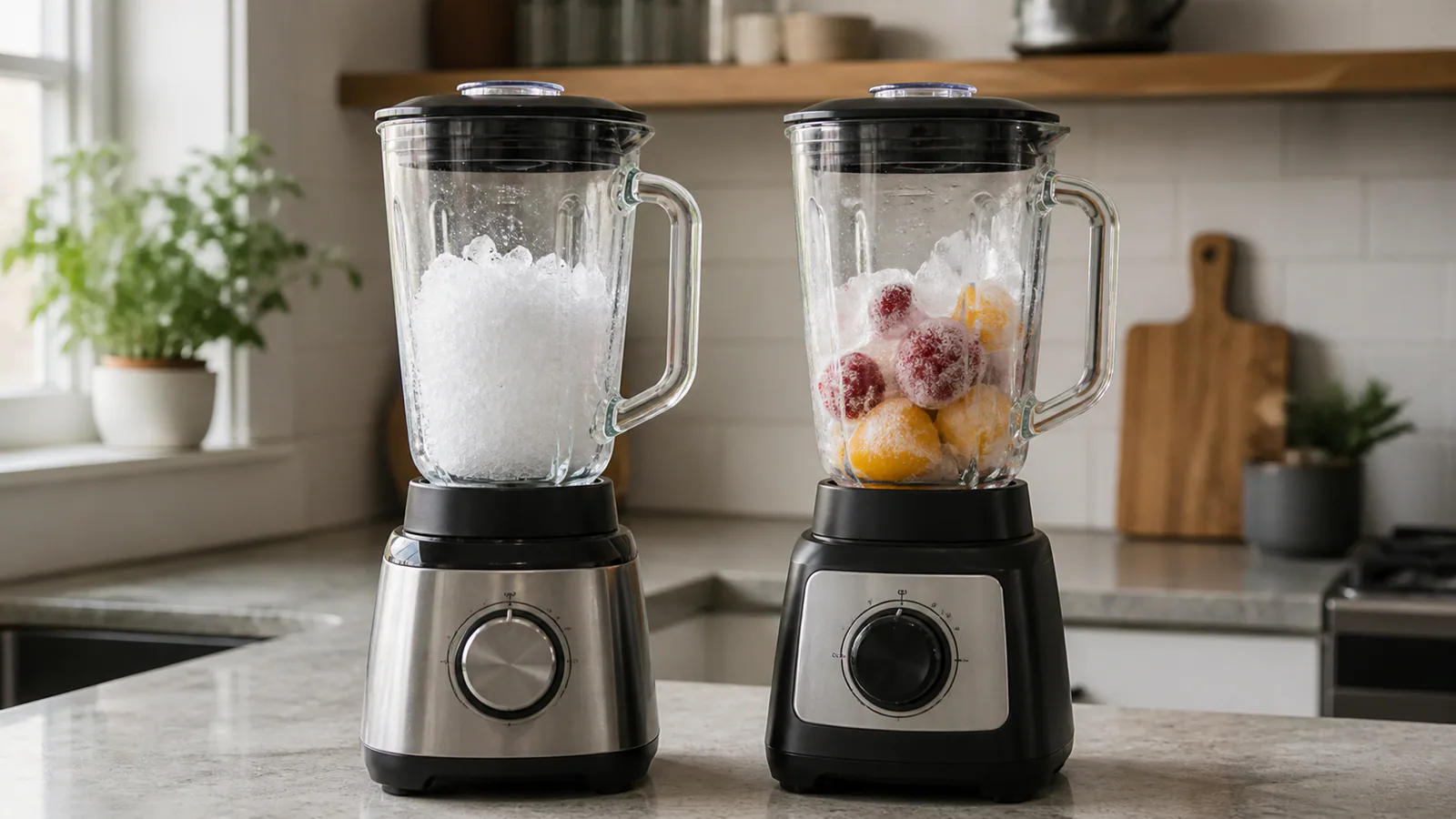
No. A higher wattage can help a blender keep moving under load, but the number on the box does not tell you whether ice will circulate through the blades or what texture will remain in the jar.
For ice, frozen fruit and thick smoothies, start with the exact model's instructions. Then compare a test using the load you actually make. Jar shape, blade reach, batch size, liquid and tamper use can reverse a wattage ranking.
A 1,000W blender beat several higher-wattage models on the same ice
Project Farm bought ten countertop blenders and put the same quantity of ice through each machine. The useful result was not a motor label; it was how much unprocessed ice remained after the same task.
| Tested blender | Claimed input | What happened in the dry-ice test |
|---|---|---|
| Ninja Professional | 1,000W | Its three-level blade assembly kept contacting the load and left no measured unprocessed ice |
| Vitamix Professional Series 750 | 1,441W | Broad blade reach produced an excellent result with a small amount remaining |
| NutriBullet Blender Combo | 1,500W | It initially stuck, then finished near the top with broad blades |
| Civio | 1,450W | Its square jar stopped circulating many cubes; roughly 20 remained |
| BioChef | 1,600W | A narrow, wedge-shaped base lost blade contact and finished near the bottom |
| WantJoin | 1,800W | A narrow jar also lost contact with the ice and finished near the bottom |
This test does not prove that every 1,000W blender beats every 1,800W blender. It proves something narrower and more useful: wattage did not rank these models' ice results. The test presenter repeatedly connected the differences to whether the jar returned cubes to the blades and how much of the load the blades could reach.
There was counterevidence too. A 650W Hamilton Beach model struggled, and higher-powered Vitamix and NutriBullet models finished near the top. Adequate motor reserve matters. It just cannot rescue a load that stays above or outside the blade path.
What wattage tells you—and what it cannot
Wattage is electrical input. It can be a useful screening signal when comparing similar machines under similar loads, but it does not directly report torque at the blades, sustained speed, cooling, jar circulation or finished texture.
A retail page that says only "2,400W" or "5,500W" gives you a specification, not a crushed-ice result. Kazakhstan marketplace listings commonly put wattage beside an ice-crushing claim, which makes the number easy to treat as a ranking. Some listings even contain conflicting speed figures between their specification fields and description. That is a reason to request exact-model evidence, not a reason to calculate performance from the larger number.
Use wattage with four other questions:
- Does the manual permit the task? Some personal blenders, glass jars or blade assemblies limit dry ice, frozen ingredients or cube size.
- What batch was tested? Six cubes, twelve cubes and a jar packed with frozen fruit are different loads.
- Did the ingredients keep circulating? A wide or rounded base and greater blade reach may return pieces to the cutting zone; a narrow pocket may strand them.
- What intervention was needed? Record liquid, pulse sequence, stopping, scraping and tamper use. A good result after three stops is not the same experience as a one-button result.
Two RTINGS results show why the batch belongs beside the score
RTINGS checks the model's instructions and uses a documented crushed-ice method. Its KitchenAid K150 review covers a 650W blender that makes good crushed ice quickly, but the manufacturer recommendation in the review limits the task to about six cubes at once. That is a credible small-batch result, not proof that the model will process a full party pitcher.
The Ninja Professional Blender 1000 review uses twelve cubes and reports snow-like ice in about 30 seconds of pulsing. Its stacked blade stem performs particularly well for ice, while the same review finds the machine less capable with some fibrous blends and unsuitable for hot blending. One strong ice score is not an all-purpose blender score.
These results are not directly ranked against the Project Farm table because the publishers use different procedures. They still support the same buying habit: keep the model, load, method and result together.
Frozen fruit is harder to predict than loose ice
A shopper in r/Smoothies described using eight ounces of liquid, six ounces of frozen fruit and three ounces of frozen yoghurt in an inexpensive blender advertised at 1,800W. It failed to blend the recipe. Replies recommended specific Ninja, Vitamix and Blendtec models, but also raised two variables that a wattage filter misses: large jars can perform poorly with very small portions, and a tamper or twisting mechanism can move food off the walls.
Another shopper reported that a 1,000W NutriBullet Select handled only four or five ice cubes with liquid before producing a burning smell. A commenter argued for at least 1,500W and reported success with a 2,200W machine. These are personal experiences, not controlled evidence, but they prevent an equally bad opposite claim: low wattage is not automatically enough.
For your own recipe, separate three jobs:
- Dry crushed ice: asks the blades and jar to recirculate hard cubes without liquid.
- Frozen fruit with liquid: depends on liquid level, portion size and whether pieces bridge above the blades.
- Very thick smoothie bowls: may deliberately resist circulation and require a tamper or purpose-built cup.
A machine can be good at one and frustrating at another.
A five-minute blender comparison for shoppers
Before buying, write down your normal recipe and batch. Then use this order:
- Read the exact manual. Search for ice, frozen fruit, maximum fill, cube size, minimum liquid and duty-cycle instructions.
- Find one same-load test. Prefer a test that shows the starting load, time, settings, interventions and unprocessed pieces—not only a final beauty shot.
- Check the jar and blades. Look for whether ingredients are directed back to the cutting zone and whether the blade assembly reaches across the base.
- Match the batch. A compact jar may be better for one smoothie; a large jar may suit family portions. Do not assume the larger jar handles every small load better.
- Compare daily friction. Pulse control, tamper access, lid fit, cleaning, noise and storage may matter more after the first week than another wattage step.
If no exact-model test exists, ask the seller to demonstrate your stated load. Record the ingredient weights, liquid, time and number of stops so the result can be repeated.
What a Kazakhstan review can and cannot tell you
On Kaspi, a 600W Kitfort KT-1356-3 listing includes one review saying the blender is weak and does not crush ice, and another saying water is needed for processing. Those comments are relevant warnings for someone who wants dry ice or a thick frozen blend. They are not a failure rate, and they do not prove that all 600W blenders behave the same way.
Treat a local review as a clue for the next question: exact ingredients, batch, liquid and method. Give more weight to repeated comments that name the same reproducible condition than to a bare star rating.
Where COSONIC CSB-7702 fits
The current public record for COSONIC CSB-7702 lists a 1,000W input, 1.5L glass jar, two speeds with pulse, stainless-steel cross blades, a dry grinder and a safety interlock. These facts make it a sensible model to compare if you want a full-size blender with manual pulse control.
They do not prove that it will reproduce the Ninja result or a particular frozen-fruit texture. Before choosing it for frequent ice-heavy recipes, check the instructions for the exact local version and ask for a same-batch demonstration. The useful question is not "Is 1,000W enough?" It is "What happens to my load in this jar, using the permitted method?"
You can also compare the current blender range, then apply the same evidence order to each exact model.
The honest conclusion
More wattage can improve motor reserve, and very low-powered machines may stall on hard loads. But wattage alone cannot rank ice texture because it leaves out jar circulation, blade reach, batch size and permitted technique.
Choose the model that proves your recipe under a repeatable method—not the box with the largest number.
Sources and evidence
- Project Farm: Best Blender? One Clear Winner! — Ten purchased blenders in a same-method comparison; one publisher and one dry-ice method, not a durability study.
- RTINGS: How We Test Blenders — Published method and manual check for repeatable blender tests.
- RTINGS: KitchenAid K150 Review — Good small-batch ice result from a 650W model within a limited recommended load.
- RTINGS: Ninja Professional Blender 1000 Review — Strong 12-cube result, with different limits on fibrous and hot blending.
- Reddit: 1,800W blender failed a frozen-fruit recipe — Detailed individual recipe and model experiences; not population evidence.
- Reddit: ice, burning smell and higher-power counterexample — Conflicting owner reports that preserve the motor-reserve counterargument.
- Kaspi: Kitfort KT-1356-3 reviews — Local individual reports on ice and added water; not prevalence data.
Blender questions shoppers ask
How many watts should a blender have for ice?
There is no universal cutoff. Use wattage as one clue, then require exact-model permission and a test at your normal batch. A 650W model can perform well on a small permitted load, while an 1,800W model can lose circulation.
Is a glass jar good for crushing ice?
Material alone does not answer the question. Check whether the exact glass jar and blade assembly permit ice, the maximum cube and batch guidance, and the result under that method.
Do I need liquid with frozen fruit?
It depends on the model, jar and recipe. Follow the manual's minimum-liquid and loading order. If you want very thick blends, choose a design that explicitly supports them and states whether a tamper is required.
Does an ice program guarantee smooth results?
No. A program controls a speed pattern; it cannot guarantee circulation for every cube size and batch. Look for the finished texture and unprocessed pieces from a repeatable test.