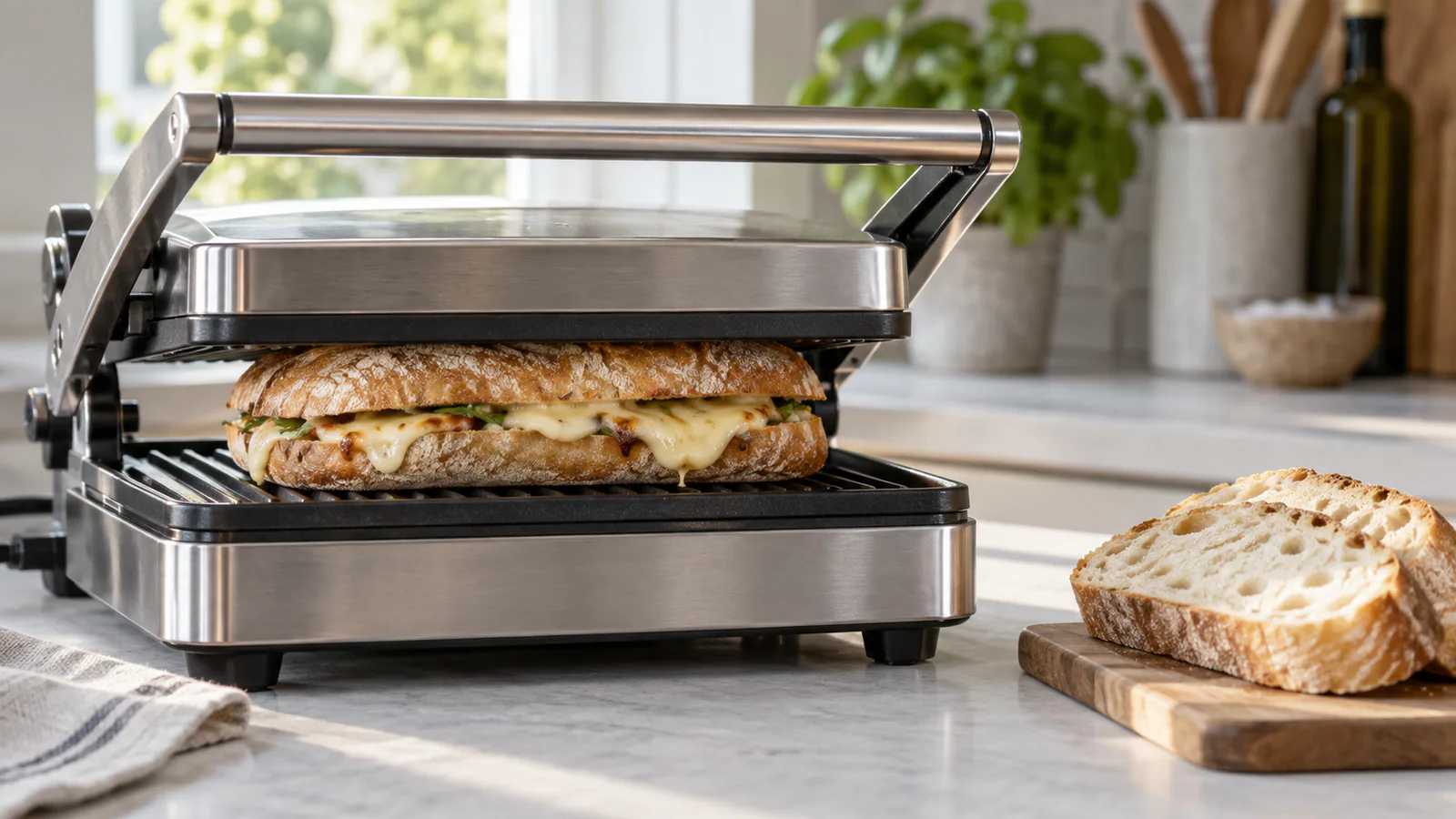
Start with the sandwich you actually make
If breakfast means a thick roll, do not choose only from photographs of thin toast triangles. The bread's footprint and the complete sandwich's height are different fit questions. A wide slice can overhang a small plate even when the filling is modest.
On the Breville VST091 review page, an owner describes trimming bread and still losing filling; another reports difficulty closing thick sliced bread around cheese. Other owners are happy with the toasties and sealed edges. These individual accounts show why your bread matters more than the phrase deep fill. They do not prove that every unit has the same problem.
Sealed pockets and a flexible lid give different results
A cut-and-seal toaster uses shaped plates to form pockets and divide the sandwich. That can be exactly the result you want with suitably sized sliced bread. A panini press offers a different format for rolls and sandwiches you want toasted without a diagonal seal.
The distinction also appears in a home-cooking discussion: participants value presses for sandwiches and wraps, while one dislikes bread compressed into pocket shapes. This is a preference to match, not a reason everyone should replace a toaster.
| Your usual sandwich | What to compare |
|---|---|
| Sliced bread with sealed triangular edges | The shaped pocket's footprint and filling space |
| Thick rolls or sandwiches of varying height | A floating upper plate and the permitted cooking gap |
| Soft bread you want to keep less compressed | How the lid's weight or height is controlled |
Floating does not automatically mean light pressure
Do not treat a floating hinge and pressure control as the same feature. Breville's BSG600 description lists a floating design alongside a separate counterweight arrangement and height adjustment. That is a useful example of why a lid that adapts to thickness may still need a different mechanism to limit compression. The model is discontinued; it is used here to explain the distinction, not as a current purchase recommendation.
In the same comparison, the COSONIC CG-W201A catalog configuration lists a floating hinge and a height-control knob. Those are relevant features when comparing different sandwich thicknesses. Check the configuration sold in your market; the feature names alone do not establish the maximum gap or how lightly the lid presses.
Check the lid controls before buying
Look for an open side-view photograph and the exact model's instructions. Check whether a control changes cooking height or merely locks the appliance for storage. The BSG600 manual, for example, explicitly reserves its lock position for storage. Other models can work differently.
Search reviews using the model name with thick bread, lid will not close or filling leaks. Give more weight to accounts that identify the bread and filling than to a star score alone. Keep positive experiences with similar sandwiches in view too.
If your normal sandwich only fits after removing most of its filling, compare a different plate shape or more suitable cooking clearance. If you enjoy small sealed toasties and your usual bread fits, a pocket toaster remains a sensible choice. You do not need a larger press simply because it has more features.