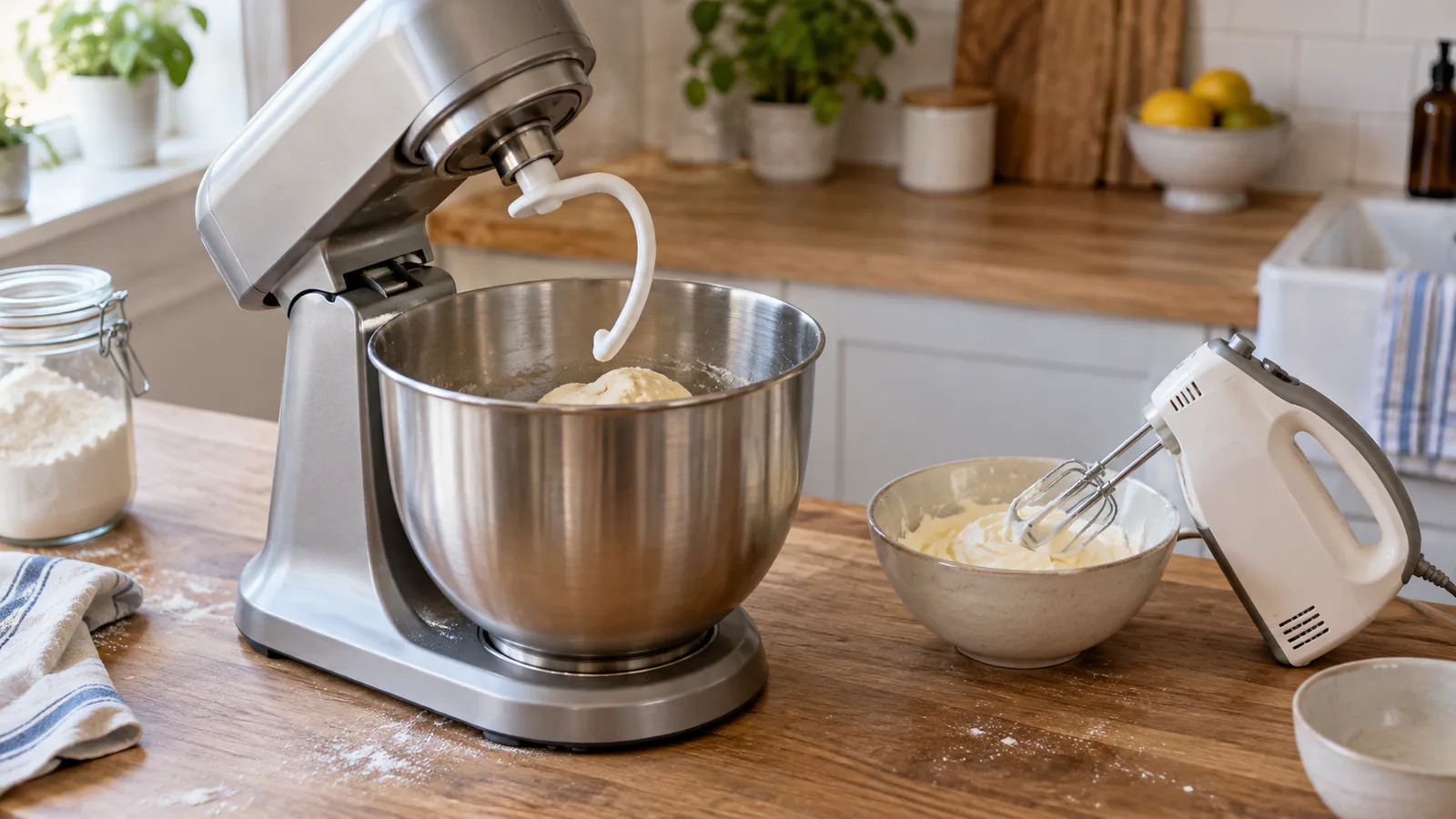
Start with the batch you make most often
An occasional celebration cake is a tempting reason to buy a bigger mixer. But if most of your baking is a small loaf, a tart or a little whipped cream, those smaller jobs should lead the choice. The useful question is whether the fitted tool reaches and works that quantity without leaving you to do much of the mixing by hand.
In a June 2024 home-baking discussion, a shopper weighed a 4.6L mixer against a 6.7L version. Owners gave different answers: some handled small recipes successfully in larger machines, while another found bread dough worked but small quantities of cream and egg whites did not. This is a reason to compare the recipe and attachment, not to reject all large bowls.
A dough hook result does not predict a whisk result
A hook, beater and whisk do different jobs. An owner of a 5.5-quart bowl-lift mixer reported a hook moving only part of a small dough batch. In a separate Seasoned Advice discussion, a buyer described small quantities sitting below the mixing tool. Replies pointed to both tool clearance and the amount and type of ingredients.
Russian-language CM-501 reviews at M.Video show the practical consequence: some owners bought for meringue, found the whisk missed ingredients and had to intervene or seek a quality check. Other owners reported successful whipping. The brand advised checking attachment installation. These are individual reports, so they cannot establish that bowl size caused the problem or that every unit behaves alike.
When reading reviews, match your task: look for bread dough if you bake bread, and cream or egg whites if you make small desserts. A general five-star rating or a large cake demonstration cannot answer both questions.
Check the small batch and the maximum separately
A bowl can hold more mixture than a machine is rated to knead. In its W11225091B manual, page 14, KitchenAid gives different dough limits for all-purpose and whole-wheat flour. For the covered 4.28L bowl, the limits are 900g and 800g of flour respectively. These are flour weights, not finished dough weights, and apply only to those models.
That manual also specifies the dough hook and speed 2 for yeast dough. A higher speed is not a universal fix for ingredients that the hook misses. Use the instructions for the exact mixer; do not copy another model's adjustment, load or speed.
The shopping comparison is therefore two-sided. Your usual small recipe needs evidence of effective mixing, while your largest planned recipe needs to stay inside the model's published limits. Neither check can be replaced by litres or watts.
A handheld option can suit small everyday jobs
If your small jobs are mainly cream, eggs or light batters, a handheld configuration is worth considering because you control where the beaters work. For example, the COSONIC CSH-1012 combines a 3.5L stainless-steel bowl with a detachable head for handheld use, two beaters and two dough hooks. That gives a choice of working position; it is not proof of a particular minimum batch or heavy-dough capacity. Follow its model instructions and the configuration sold locally.
If hands-free kneading is your main reason to buy, handheld operation may not solve your problem. Look instead for an exact-model demonstration using a dough similar to yours, including the flour quantity. The larger-mixer owners who reported success are a useful reminder: a big bowl can still be the right choice when the actual recipe works well.
Compare these details before you buy
- Start with your usual recipe: note its flour weight for dough, or its cream or egg-white quantity for whipping. Keep flour weight and total mixture weight separate.
- Search the exact model with “small batch dough” or “one egg white”. For Russian-language reviews, try “маленькая порция” and “венчик не достаёт до дна”. Look for the attachment, quantity and result, including contrary experiences.
- Open the model's manual to check recipe limits and attachment compatibility. A smaller replacement bowl is useful only if the manufacturer confirms it works with the required tool.
- If the only evidence is bowl size, wattage or large-batch demonstrations, keep comparing models. Do not buy extra capacity on the assumption that every smaller recipe will work equally well.